

47% of B2B decision makers now look for answers in ChatGPT, not on Google
Something has changed in the way the people who decide marketing budgets look for information. Before opening Google, a growing number of Marketing Managers, CMOs and business owners type their question straight into ChatGPT, Gemini or Copilot. They aren't looking for ten blue links to compare: they want a synthesised, already-reasoned answer, ideally with the names of the right companies to click on. According to Profound's 2026 research on B2B buyer behaviour, around 47% of decision makers say they turn to an AI assistant first when they need to evaluate a vendor, a tool or a strategy.
This shift has a precise and uncomfortable consequence: an invisible war between brands to be "the answer" has begun. When a prospect asks an Answer Engine "which is the best agency for my need" or "is it worth investing in this technology", the assistant names two or three companies. If your competitor is among those names and you are not, you have lost the conversation before it even started. Not because your product is worse, but because in that channel your company simply does not exist.
The critical point is that traditional SEO does not prepare you for this. Ranking on Google's first page optimises for a behaviour — the user scrolling results and choosing a link — that a growing share of decision makers is skipping. Answer Engines don't read the SERP like a human: they extract, synthesise and cite sources according to their own logic. You need different signals, differently structured content, and a strategy designed to be cited, not just found. This is Answer Engine Optimization, or AEO.
There's also a signal already in front of you: Google's AI Overview. When you run an informational query, more and more often the first thing you see is not an organic result but an AI-generated box that answers directly, citing a few sources. It's the same mechanism as conversational assistants, brought inside the search engine you already know. Even staying "only" on Google, then, the game is shifting: it's no longer enough to appear among the links — you have to be the source the AI chooses to cite in the box at the top of the page.
This article is not a technical guide for developers. It's written for those who decide what to do with the marketing budget, not for those who implement it. In the sections below you'll find the quantified business case for AEO, a benchmark against SEO and PPC, a three-minute self-assessment, a 90-day operational roadmap and the KPIs that really matter.
The real ROI of AEO visibility: what is it worth to be cited in Answer Engines?
When an acquisition channel is new, every decision maker's first question is the same: how much does it return and how much does it cost. AEO is still a young market, but the benchmarks emerging from the first structured campaigns tell an interesting story. They are worth treating as reference estimates to validate on your own case, not as guarantees: AEO rewards early movers, and today's numbers reflect a window of low competition that won't stay open for long.
Lower acquisition cost. The first observed advantage is economic. Leads generated by Answer Engine visibility tend to cost less than those from traditional SEO, with customer-acquisition-cost (CAC) reductions on the order of 48% in industry benchmarks. The reason is structural: someone arriving from an AI citation has already been "pre-qualified" by the assistant, which pointed them to you as a relevant answer to their specific question.
Lead quality. The same pre-qualification mechanism shows up in conversion rates. Leads from AI sources show a higher conversion rate — around +37% in the available data — than leads from generalist channels. Someone who reaches you after ChatGPT pointed to you as the solution arrives with more mature intent and less need to be convinced from scratch.
Time-to-first-results. A well-run AEO campaign starts producing citations and traffic in 3-4 months, versus the 6-12 months typical of a competitive SEO project. That's because Answer Engines re-evaluate content faster than crawling and organic-ranking cycles, and reward informational clarity more than pure domain authority.
Penetration advantage. The most underrated strategic benefit is the "top-three cited" effect. Space in Answer Engines is scarce: the assistant names very few sources. Being among the first companies cited in your sector builds a defensible advantage, because models tend to consolidate the sources they have already learned to consider authoritative on a topic. It's a cumulative effect: the more you're cited, the more you become the "default" answer. Unlike PPC, where the advantage evaporates with the budget, here the position you win tends to hold over time at a much lower maintenance cost.
Then there's a variable that weighs more than all the others combined: timing. The low cost-per-lead and fast activation times you see today are not a permanent feature of AEO — they reflect a market that is still uncrowded. As more companies start optimising for Answer Engines, the scarce citation space will become more contested, and costs and timelines will rise with it. It's the same dynamic SEO went through fifteen years ago and PPC more recently. Those who move early pay less and build a position that others will struggle to dislodge.
It's only fair to state the flip side too: AEO is a young channel, measurement tools are still evolving, and the available benchmarks rest on fewer campaigns than mature channels. That's why it's correct to treat the figures here as reference estimates and to set up a solid measurement system from day one, validating results on your own real case.
To make it concrete, consider a realistic benchmark for a mid-sized B2B marketing agency — the profile Miramedia uses as a reference. With an investment in the region of €3,500-6,000 and a 4-month timeline, the achievable goal is a +50% increase in qualified leads and a first-year ROI around 3.7x. Treat these as benchmark estimates, to be verified against your own baseline and your average deal value.
AEO vs SEO vs PPC: which channel should you choose in 2026?
No single channel wins on its own. The right question isn't "AEO or SEO", but "how do I combine channels based on objective, budget and time horizon". The table below compares the four main options on the metrics a decision maker actually weighs.
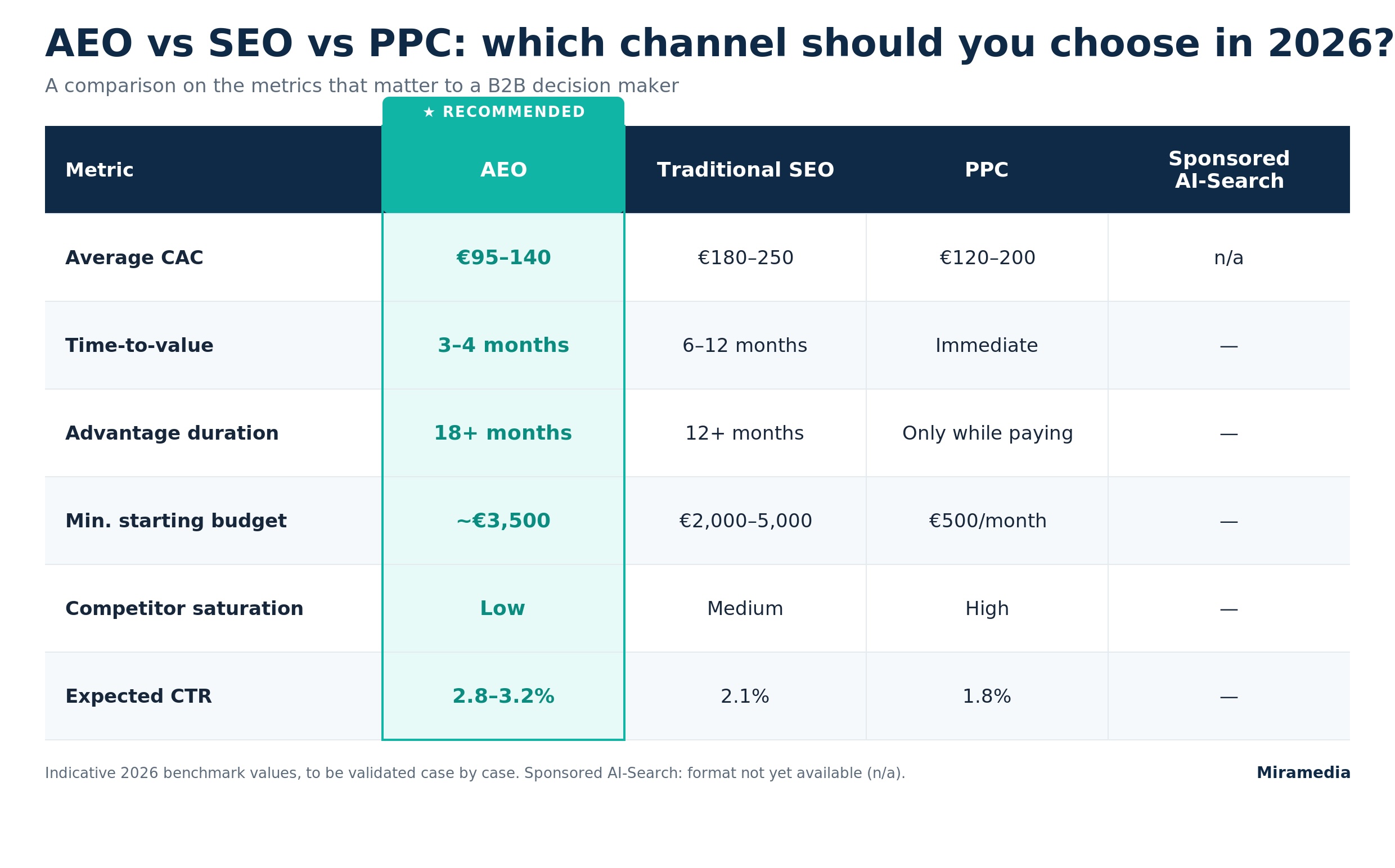
The strategic read is simple. PPC remains the channel of immediacy: you pay and you're visible today, but the advantage vanishes the moment you switch off the budget. SEO builds a durable asset but takes time and operates on already-crowded ground. AEO today offers the rarest combination: short activation times, low cost-per-lead and — above all — still-limited competition that makes the advantage easier to win and to defend.
The key takeaway: AEO does not replace SEO, it completes it. Much of the work that makes content citable by an Answer Engine — clear structure, verifiable data, authority — also strengthens traditional organic ranking. In 2026 the digital strategy that works has both: SEO covers those still searching on Google, AEO covers those who have already shifted their questions to AI assistants.
How do you translate this into budget decisions? A practical rule: if you need immediate, measurable results (a launch, a trade show) PPC covers the window. If you're building long-term positioning, SEO and AEO should be started together, because they share most of the groundwork. And if you operate in a sector where AEO competition is still absent, it's worth over-weighting AEO now: it's the move with the best ratio of investment to defensible advantage the market offers right now.
Is your company ready for AEO? A 3-minute self-assessment
Before allocating budget, it's worth understanding your starting point. Answer these five questions, giving yourself one point for every "yes".
0-1 points — Not ready yet. Start from traditional SEO and a solid content base.
2-3 points — Halfway there. You can start AEO in parallel, working on the gaps (markup, monitoring, editorial cadence).
4-5 points — You're ready. AEO can accelerate your marketing results within 90 days. The time to move is now.
How to get started: an AEO roadmap from zero to "visible in Answer Engines" in 90 days
An AEO project isn't a one-off intervention but a phased journey. The underlying logic is always the same: first understand where you are, then put the technical foundations in order, then make content genuinely citable, finally measure and correct.
Phase 1 — Audit (weeks 1-2)
It starts with a snapshot of what exists: analysis of strategic content already published, review of current schema.org, identification of 5-10 target keywords and questions you want to be cited for. This phase also sets the starting benchmark — where and how much your company appears in Answer Engines today.
Phase 2 — Technical implementation (weeks 3-6)
Work focuses on top content: adding and fixing schema.org markup, structuring information in question-and-answer (FAQ) format, verifying and updating structured data. It's the "invisible" work that makes content readable and reusable by AI assistants.
Phase 3 — Content restructuring (weeks 5-10)
About five key pieces of content are rewritten for AI citability: clear, self-contained answers, structured FAQs, and a strengthening of E-E-A-T signals through citations, real data and expert contributions. In practice it means writing so that each paragraph can "stand on its own": an explicit question followed by a concise, verifiable answer is far easier for an AI assistant to extract and cite. It's a shift in editorial mindset more than a technical intervention.
Phase 4 — Monitoring (ongoing)
Once up and running, the work is continuous: monitoring brand citations in AI, tracking referral traffic from AI sources, updating metrics monthly.
Expected costs and timelines. Run in-house, a first cycle requires roughly €3,500-5,000 plus about 80 hours of team time. With a specialised agency, the investment rises to €6,000-8,000 all-inclusive, with compressed timelines. In both cases the first visible results arrive in 3-4 months and ROI breakeven typically lands between the sixth and eighth month.
How to measure AEO visibility: the KPIs that really matter
Measuring AEO requires a layered logic: from raw visibility down to business impact. Confusing the layers — for example celebrating citations without checking leads — is the most common mistake.
Level 1 — Visibility. Number of brand citations in AI for target queries, share of voice versus competitors, and citation quality: being "among the top three cited" weighs far more than being "cited but not primary".
Level 2 — Traffic. Referral traffic from AI sources (chat.openai.com, gemini.google.com, copilot.microsoft.com), month-over-month growth, and the ratio of AI traffic to total organic traffic.
Level 3 — Business. Qualified leads attributed to AI sources (via dedicated UTM parameters), AEO CAC compared with other channels, and the conversion rate of AI-sourced leads. This is where you verify whether the channel really pays.
The trickiest knot is attribution. Traffic from AI assistants doesn't always arrive with a clean referral: sometimes the user reads the citation, remembers the brand and searches for you directly later. Set dedicated UTMs on links in optimised content, cross-reference spikes in direct traffic and brand search with rises in citations, and ask new leads how they found you. It's the combined reading of these signals that gives the true measure of impact.
Operationally, an effective dashboard combines an AI-monitoring tool such as Profound.io with Google Analytics 4 for UTM tracking, with monthly reporting and a quarterly trend read. The goal isn't to chase a single month's figure, but to recognise the direction.
Case study: how a B2B marketing agency gained +50% leads in 4 months
To make all of the above tangible, here is a reference case that reflects the typical profile of a Miramedia client. The figures should be read as a representative benchmark, to be calibrated against your own starting point.
Baseline. The company started from around 3,200 visits/month and 12 leads/month, with virtually no presence in Answer Engines.
Objective. Become visible in at least three Answer Engines on the sector's strategic queries and bring lead generation to +18 per month.
Investment and timeline. A budget of €4,200 over a 4-month horizon, structured according to the four-phase roadmap.
Result. A +50% increase in qualified leads and a first-year ROI of 3.7x. With an average deal value for AEO consulting around €4,500, the increase in qualified leads repays the initial investment well within the year, while also building a visibility asset that keeps producing in the months that follow.
Conclusion: the time to decide is now
AEO isn't an experimental bet, it's a strategic decision with a time window. Competition in your sector is probably still low — but that's exactly the condition that won't last. Those who build Answer Engine visibility today accumulate an advantage that will become increasingly expensive for latecomers to recover.
The question to bring to the next budget meeting isn't "whether" to move on AEO, but "when", and the honest answer is: before your competitors.
Plan your AEO strategy — request a personalised assessment and discover the estimated ROI for your company.